Spain and Portugal – Regua to Porto by Train
Previous day || Back to trip summary page ¦¦ Next day

Regua to Porto by Train
After a quiet night on the aire de camping cars at Regua, we eat breakfast and get on our way to Régua station about 10.00am to catch 10.48 train to Porto. Visiting cities by train is something that we often do when travelling in our motorhome. We know from experience that driving a motorhome through the narrow, crowded streets of most cities is not a good idea. Parking is difficult, especially as many european cities have underground car parks with height restrictions. We research the area around the city, looking for camping sites and motorhome aires, looking especially for locations that are within walking distance of a railway station. Usually the rail fares are surprisingly low when compared to the UK fares, for example the return train journey from Regua to Porto cost us €11.97 each, a similar distance rail trip in the UK costs over €30, almost three times the cost.
We are disappointed that the train that arrives is a diesel multiple unit (DMU), a perfectly good train with plenty of seats but not the class 20 traction-hauled train we had hoped for. We think these are only the ‘stopping trains’ from Pocinho station.
The journey to Porto takes just over two hours, at least half runs along the side of the Douro River. The day is still dull and overcast so not the best day for photos, but at least it is not raining.
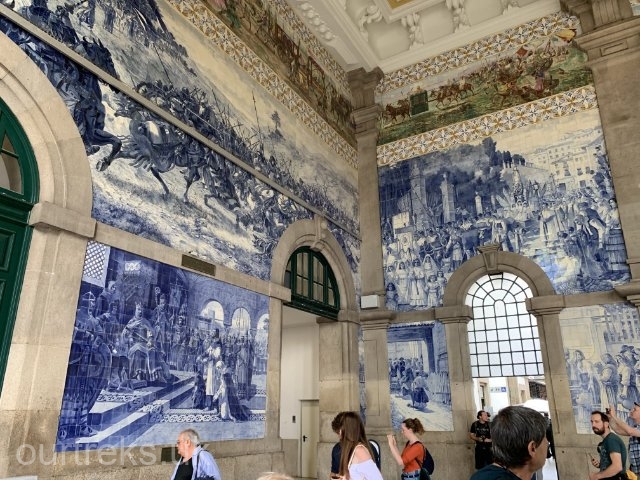
Porto Sao Bento station is a renowned for its tiled hall and 19th century style. It turns out to be the best building in Porto! We emerge from the station into the heat of midday, a million tourists, the meeting of about five very busy roads at traffic lights and one of the termini for the Hop on-Hop off bus. After the semi-rural peace of even of Régua it is overwhelming.
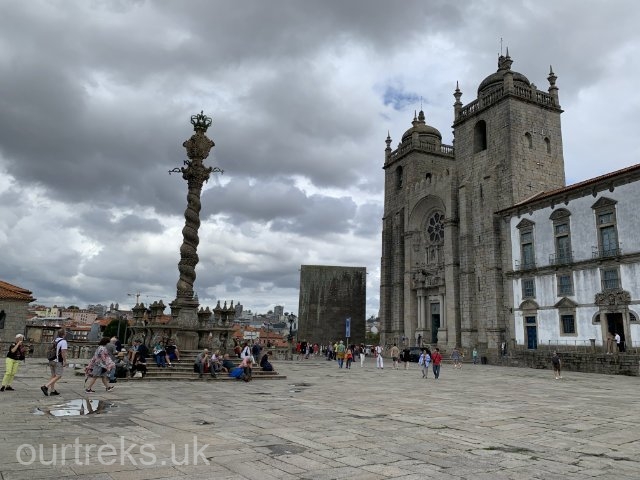
Porto is built on a series of hills, we walk up the first to the Cathedral (Sé de Porto) and sit on a low wall to have lunch, there are no seats or benches. It is overcrowded, dirty and dominated by amplified ‘music’ (without apparent tune) from a man with a saxophone. People are milling about all over the place, groups of tourists (many American) with interpreters wander in straddling groups across the grass, a few smart office workers walking with purpose to where they need to go.
After our lunch we walk up to the plaza in front of Porto cathedral with the statue of Vimara Peres (here another ‘musician’ is playing equally discordant music) and photograph the view over the river and the city. Everywhere is dirty, piles of rubbish and empty, broken and derelict buildings are everywhere. We walk up again to Avenida Vimara Peres and walk downhill again (with the Metro in the middle of the road) to Ponte Luis I. The iconic metal bridge is high and spans the Douro River and its valley with good views across to the city and of the plazas and eating terraces along the river. The footpath is so crowded it is hard to walk. At the other side there is more live music and singing and more crowds.
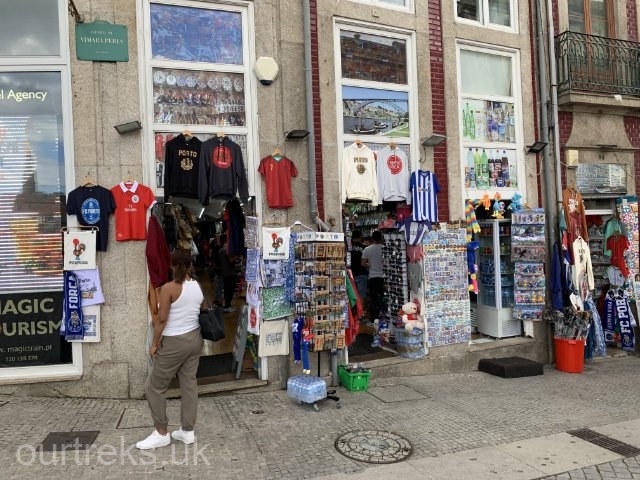
We return to the station and wait for the train, another DMU, back to Régua. Porto was a big disappointment, too many tourists crowding everywhere we went, too many tour buses and other contrivances designed for tourists. It felt like Porto had sold itself to the highest bidder.
Back at the camper in Regua it is hot and sunny, we sit inside and drink wine feeling the stillness at the end of a very hot and noisy day. We sit and reflect on the day: the train journey and Porto was interesting but we agree that the best views of the Douro valley are from the Hymer as we climb over the mountains. Later, after a tea of chicken green Thai curry, we walk up to the high-level bridge in the dark and enjoy the cool of the evening and the view.
Gallery Regua to Porto by Train
Click at image to enlarge