2017-09-27 Spain – Roman and Moorish sites Seville Italica and Arecena
Previous Day :: Trek Overview :: Next Day

Spain – Roman and Moorish sites Seville Italica and Arecena
Roman and Moorish Sites in Spain by Hymer Motorhome
Seville, Italica at Santeponte and Arecena
When we wake it feels deliciously cool, the temperature has dropped to 17°C. Outside it is cloudy, no clear blue sky today, it even looks like it might rain! We look at the weather forecast and indeed rain is forecast for 10.00am, we try to book tickets online to enter the Alcazar but are unable to. We breakfast and pull on our clothes and walk back to the Plaza de Espana, the fun and party atmosphere of the night before is gone, it is a flat grey day.
We walk through the park looking for the Alcazar as Geneva said it was really worth a visit. The park was pleasant but the Alcazar was illusive. After much walking we find the cathedral, and knowing that the Alcazar is behind it, we follow the outer wall. Odd that there are NO signs! Thank goodness for Google maps. By the time we do find it, there are long, long queues. Geneva said they had waited 45 minutes and we did not want to wait that long and, perhaps, we are not that motivated to see another Alcazar.
We walk back in light drizzling rain towards the river and look at the Torre de Oro, a round tower made of local golden sandstone, we don’t go in or climb to the top. We return to the camper and have lunch then, leaving Seville, we drive to Santiponce, about 9 km north of Seville. The rain has stopped by the time we arrive, and it is warm again, but only 24°C, so it feels fresh. It is free entry to Italica for EU citizens and we spend at least two hours walking around the well preserved Roman city.
The Roman general Publius Cornelius Scipio built Italica in 206 BC, in order to provide housing for his veteran (retired) Roman army who had defeated Hannibal and the Carthaginians in the Second Punic Wars in North Africa. With a Forum and public buildings at the centre, the streets extend outwards and down to the Guadalquivir river where the river ports would bring in and take out goods from the city. Everything is here… a large amphitheatre that seated 25,000 spectators (about half as many as the Colosseum in Rome) is in remarkably good condition with its oval arena for chariot racing and gladiatorial battles. The underground tunnels in the amphitheatre’s vault led to holding rooms near the arena and left little to the imagination of what happened to Christians or those who fell afoul of the law.
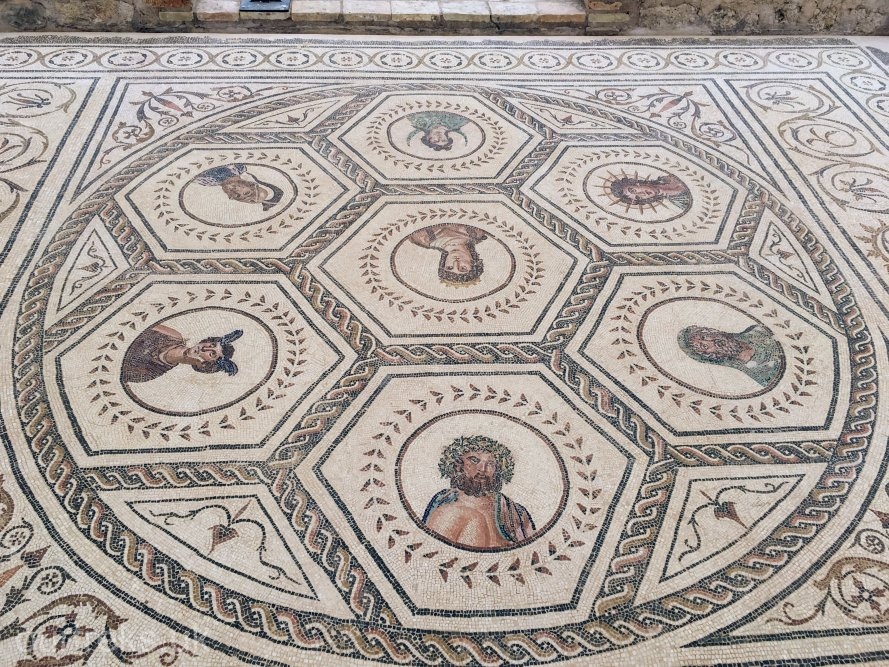
We spent time exploring the cobbled streets, some wide with evidence of carts where their wheels had left grooves in the stone. Typical of Roman architecture, the houses were quite small but opened onto large square courtyards for outdoor living in the warm and dry climate of Seville. Grander houses with marvellous mosaics floors, some of the best we have ever see – photos below. Many were still in-tact and some restored: the house of birds, a full floor mosaic depicting nine different bird motifs. Similarly, the house of planets with different Roman Gods in a circular mosaic. We were mesmerised by their quality and beauty and listened to others gasp as they saw them for the first time.
The elaborate system of water channels ensured water and baths to each house. A 37 km aqueduct (built by Hadrian… he of the ‘wall’ fame and born in Italica) brought the water from the river into large underground cisterns in the city. Built on a hillside, the natural slope of the land took the waste water away from the streets and latrines via a sophisticated sewer system. The restoration of the city is ongoing, but the quality of the restoration is quite remarkable .
The write up tells us:
Italica was the birthplace of three Roman emperors: Trajan and Hadrian (and possibly Theodosius). It was one of the earliest Roman settlements in Spain and built near the Guadalquivir river. it was founded in 206 BC by Publius Cornelius Scipio as a settlement for the legionaries retired after the battle of Ilipa (second Punic wars). It was during this was that Hannibal and the Carthaginians (from North Africa) were defeated by the Roman army led by Scipio. By the 2nd century AD, Italica had expanded to a population of 8,000 and had social and military status when Trajan and his nephew Hadrian were in power.
The area was a major producer of grain and olive oil, and some families with private farms became very wealthy exporting to Rome. The 25,000-seater amphitheatre was one of the largest in the Roman Empire, it has partly survived (two storeys out of three). The central pit was used for animal cages (bears and wild boar) during gladiatorial combats. In 2016 it was used as a filming location for Game of Thrones. Beyond this, on and around the wide main avenue or Cardus Maximus, about five large houses of prosperous families have been excavated, some with well-preserved, colourful mosaics, including floors with exquisite design of birds, Neptune, and the planets. These mansions measured up to 15,000m2. There is also the remains of the Traianeum, temple of the Emperor Trajan, Termas Menores and Mayores (baths), and the sophisticated sewer system normally seen in larger cities.
It was hard to leave, but leave we must. We drive north on the N630 to El Garrobo where we turn onto the N433 to Aracena, a drive of 75km which took just under two hours. We leave the flat yellow plain and industrial Seville behind (the least satisfying of all our driving in Spain) and climb again into the mountains, to 720m. We follow signs for Portugal and realise we are only about 100km from the Portuguese border. Now, olive trees give way to row after row of cork oak trees, their black trunks stripped to chestnut brown nakedness where the cork has been peeled away. It reminds us of Portugal, which is the world’s largest cork producer.
We stop first at a campsite just out of town but find it closed. So, we drive into the town and park on the car park there. It is supposed to have spaces allocated for motor homes but these seem to have gone so we park at the far end. There are no services here, but we have sufficient water for a couple of days. We settle in beneath the impressive Aracena castle perched high on the hill. Later we wander around the town of Arecena and discover a SPAR supermarket that has the most extensive range of goat and sheep cheese that we have found on our travels. We purchase a number of cheeses. The altitude here is about 650m and the evening is warm and sunny, we sit under the shadow of the castle until dusk.
Our Hymer motorhome trip to Roman and Moorish Sites in Spain
Click any photo to enlarge