Isaba to Canfranc Estacíon
Previous day || Back to trip summary page || Next day
Isaba to Canfranc Estacíon
Motorhome Journey – Isaba to Canfranc Estacíon
The cars start to arrive early and we hear them driving up the steep hill to park on the field. Many of the people from the motorhomes on our site have their cycling gear on and are getting their bikes in order. They leave in small groups from about 9.00 am onwards, it is a bike ride not a race so each joins in, in their own time.
Larra-Belagua is a protected natural area located in the Roncal valley, 1,026 m / 3,366 ft above sea level. It is one of the wildest and most unique landscapes in Navarra. For cyclists, the final 9.4-kilometer climb at 6.1% gradient constitutes a first-category mountain pass that has earned a place in the history of La Vuelta a España since its debut in 2023. The asphalt in perfect condition and the absence of traffic make this ascent a unique experience, demanding a constant rhythm and rewarding the cyclist with privileged views over the Navarrese Pyrenees.
By late morning most of the cyclists have left and the site is eerily quiet, we walk into the town. Mr C. looks for bread but buys beer (!!) and I buy some local Roncal cheese made from sheep’s milk. We leave Isaba about 11.00 am but have an anxious moment when Hymer’s battery complains and it takes several turns to get it going, finally sparking into life, we wonder if the battery is low because of the slow driving on many steep hills. We decide not to service Hymer on the disposal area, it is small with a large riser to bump up and over onto to emptying area for the grey water; but we do empty the toilet cassette and top up with a few watering cans of drinking water.
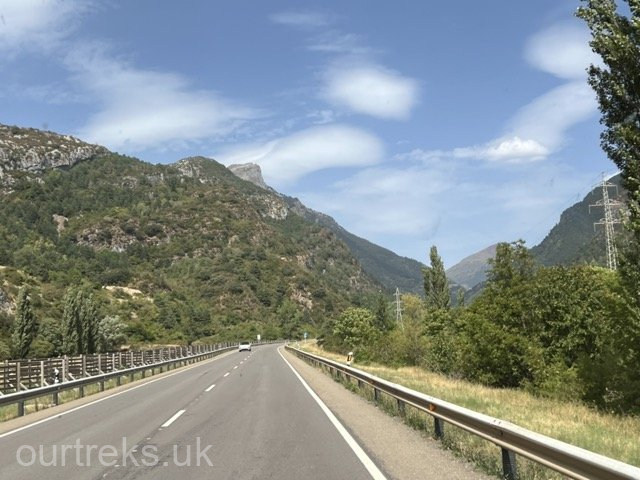
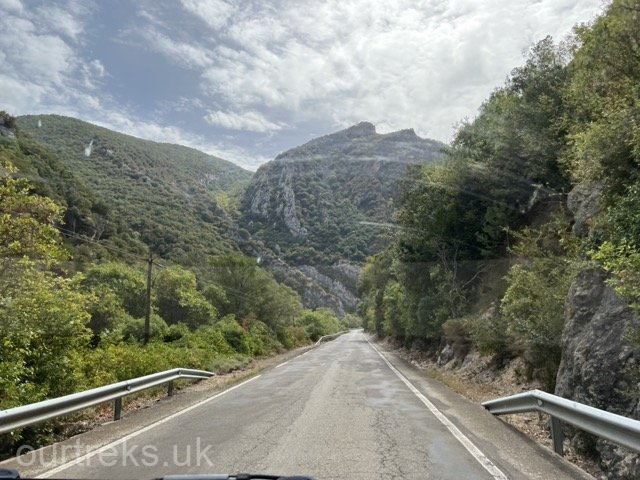
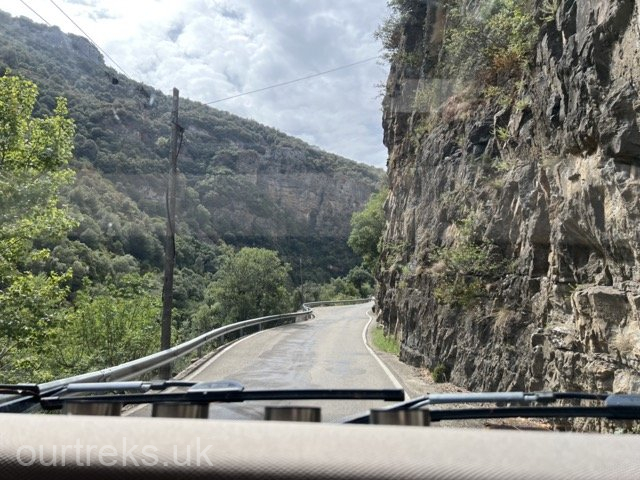
We leave down the steep hill past the 70+ mohos and join N-137 that runs along the horizontal bottom of the river valley where we follow the Rio Esca. Through Roncal and Burgui Burgi to Sigüés where we turn east towards Jaca on N-240 now following the Rio Aragón along another deep valley, lined both sides with vertical rock walls. In places we see griffin vultures lazily circling on the thermals, about 20 of them in one place, also a few mountain goats. Nothing grows here; it is either rocky and barren or dry grey volcanic earth. In places a vast lunar landscape of grey hoodoos that line the valley. In places we drive sections of A-21, a fast dual carriageway road, sections of which were not yet completed when we came to this area in 2018 and stayed at Sos del Rey Católico (the town with bronze Directors Chairs in the centre).
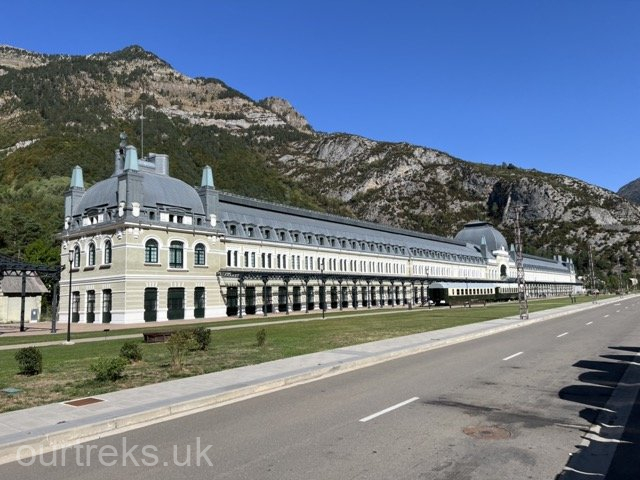
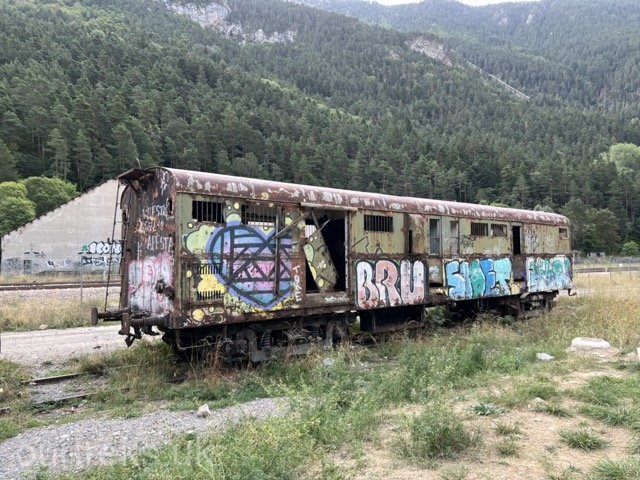
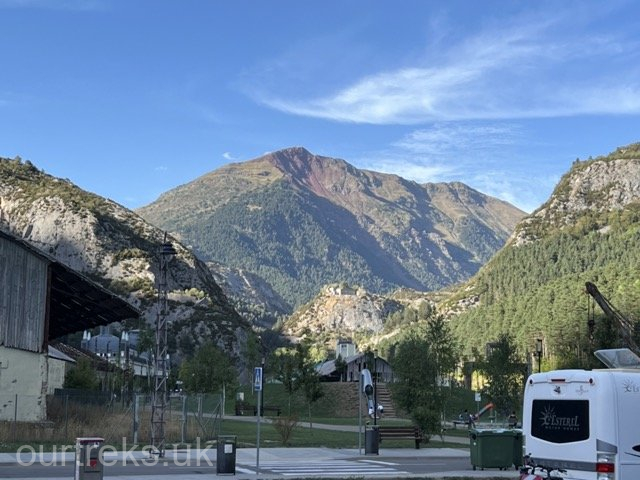
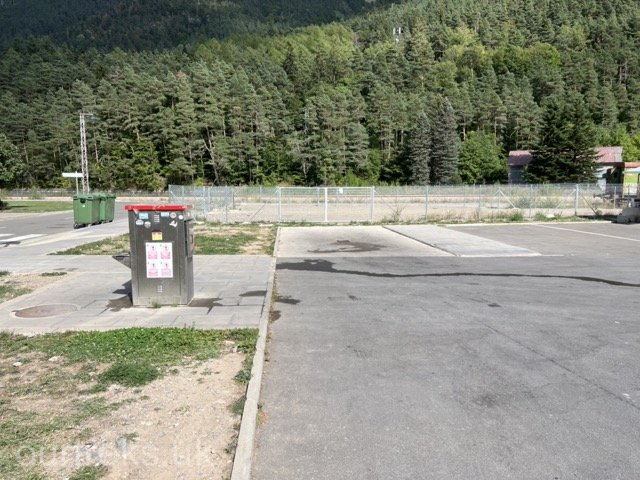
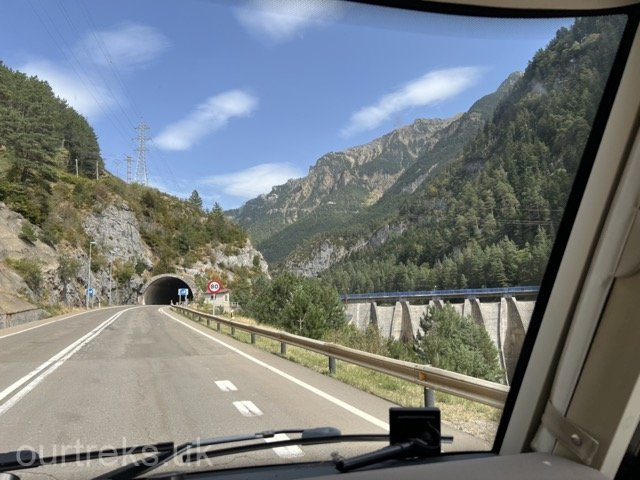
It is a good drive to Jaca, a larger than expected town, where we turn north on N-330 towards France (only 30 km away). Still in the Spanish Pyrenees and another mountainous area with a slow steady climb from Jaca at 830 m to Canfranc at almost 1200 m. Following the railway from Jaca along the valley, it runs parallel to us but halfway up the mountain side, through tunnels and across terraces to the next tunnel. The railway line goes to Canfranc (our destination), a large junction (most of it unused now) but the number of lines, size of the marshalling yard and semi-circular engine shed with turntable (no longer usable) suggest it must have been exceptionally busy in times past, carrying freight between France and Spain. We find the Area Autocaravanas behind the station, in fact there are two: one free like a parking lot and a second with hook-up, water and emptying facilities and slightly larger pitches, €9/night.
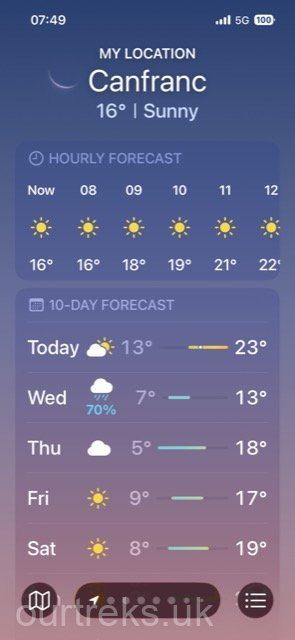
We drive onto this one and park up, the Parking Rita comes over and helps us log on with the App and we pay that way. There are 20 spaces and 14 of us spend the night here. Despite being at an elevation of 1,040 m / 3,410 ft it is hot, very hot, the temperature inside and out is 34°C, too hot to get cool. We look at the weather apps and see that northern Spain/southern France, the Pyrénées area is currently under a ‘weather dome’ an area of exceptionally hot weather trapped under ‘a dome’ of hot air. We can confirm that!! We walk to the station, only a few hundred meters, and spend some time there exploring station and hotel.
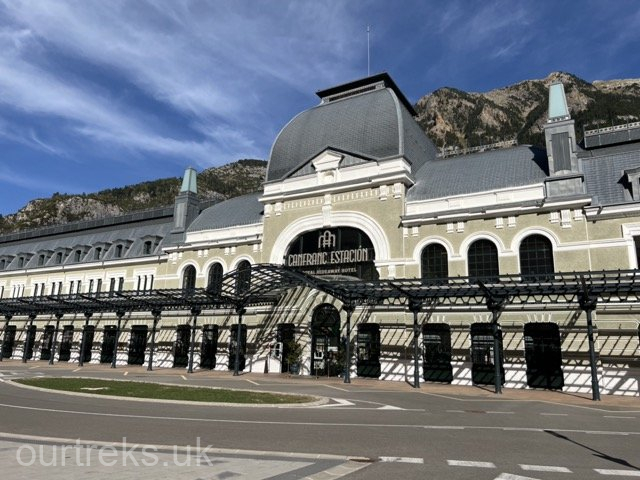
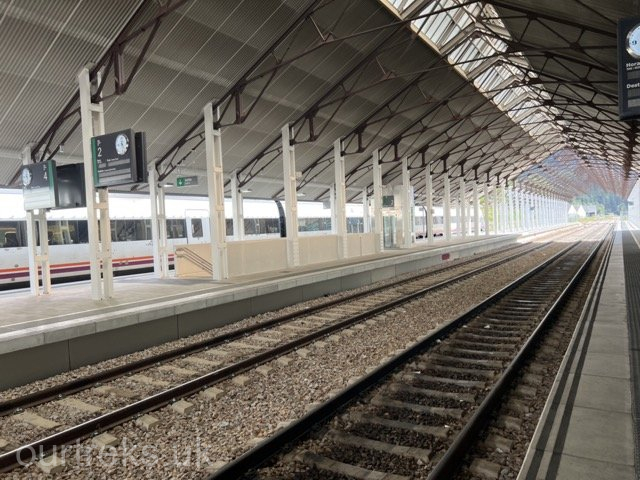
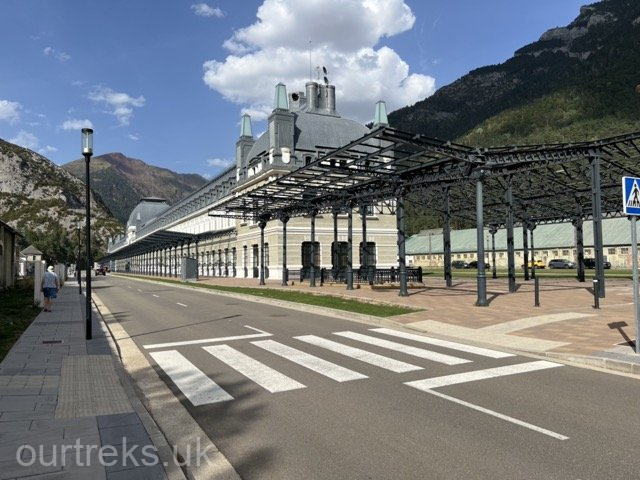
Opened in 1928 Canfranc has served as a border station between France and Spain since that time. After a grand scale rebuild in the Beaux-Arts style it was converted into a luxury hotel that opened in 2021. Large quantities of glass, iron and cement are present throughout the structure, the hotel alone having 365 individual windows. The station (and hotel) originally operated as a major hub for cross-border railway traffic, since 2021 the 5* hotel has operated separately. Canfranc Estacion itself consists of two platforms and a hall that are linked to the hotel.
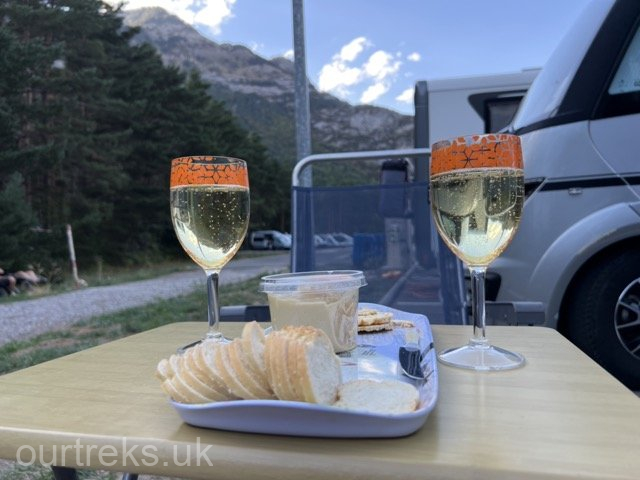
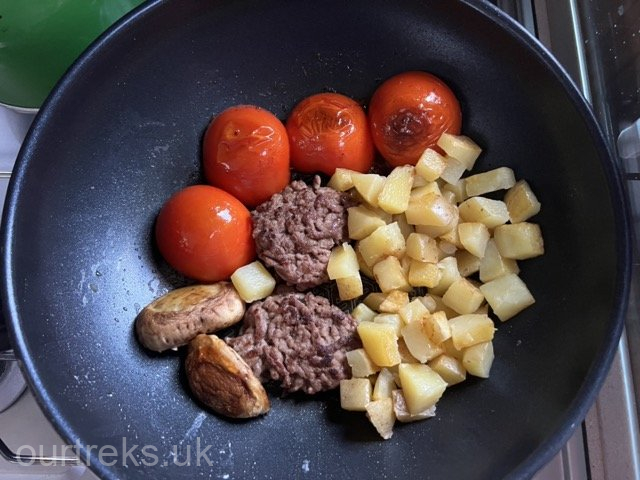
Crossing the road to the small Al Campo supermarket we buy a few essential supplies and walk back. The temperature is in the mid-thirties and the sun is very hot. Mr C. feels lightheaded, so using cold water on his body and the fan to dry himself it is sufficiently cooling to bring his temperature down and he starts to feel better. We take the view that we just need to ‘sit out’ this extreme hot weather, which should start to reduce perhaps tomorrow. We sit, read and journal, watching as the trains from Jaca come and go every hour or two. After six the sun moves behind the mountain and we feel a slight improvement, sitting out in the shade we open wine and much later cook chicken and mushrooms for tea. The griffin vultures come out from behind the mountain ridge in the east and we watch them rise and circle lazily on the thermals.
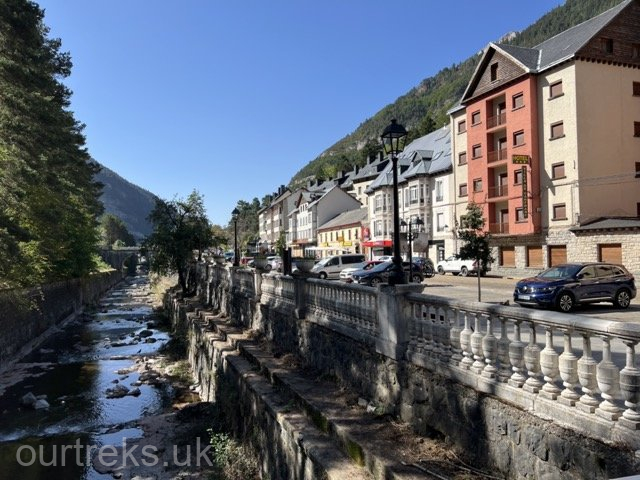
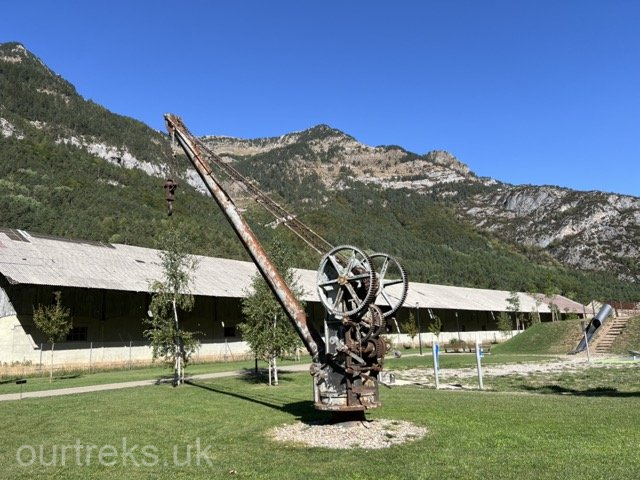
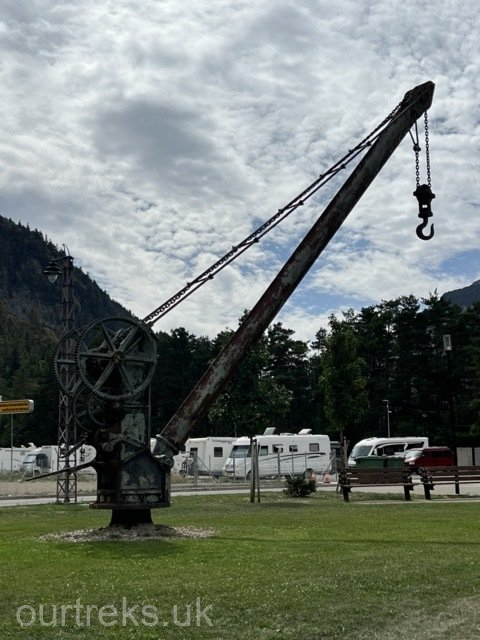
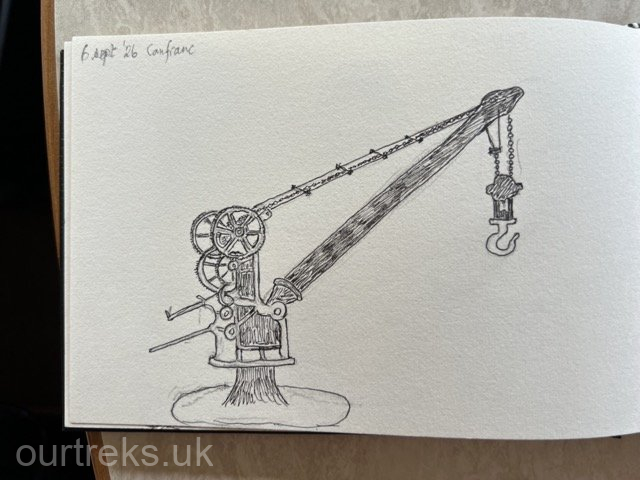
Photos in and around Canfranc Estacíon, Spain
click on any photo to enlarge and view as slides