Spain and Portugal – Astorga to Saldaña
Previous day || Back to trip summary page ¦¦ Next day
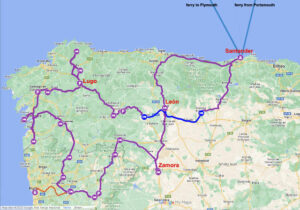
After a quiet night on the area de servicio para autocaravanas at Astorga, we breakfast and service the Hymer before we leave Astorga, but do not fill with drinking water as there is no separate tap to the toilet cassette washing.
We leave Astorga on the N-120 and as we drive past Órbigo towards León we see hundreds of pilgrim walking west (in the opposite direction to us). The Camino de Santiago runs along this section of N-120 all the way to León city centre, which we bypass via Onzonilla. We take the A-231 to Sahagún and begin to cross the great central plain of Spain south of the Montaña Palentina mountain range (and national park). At Ledigos we take the P-235, a small road across the plain to La Olmeda.
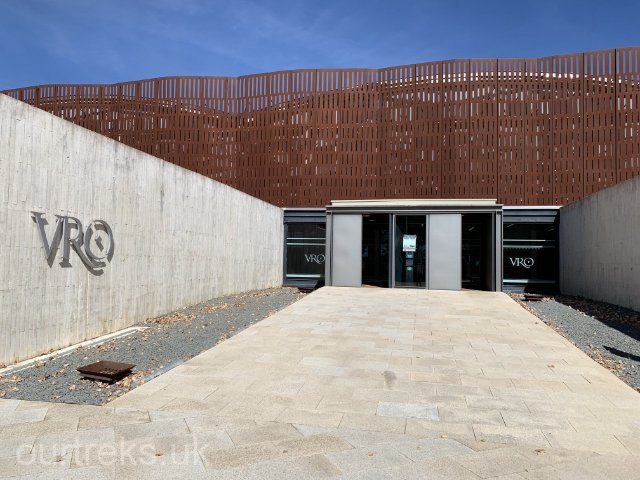
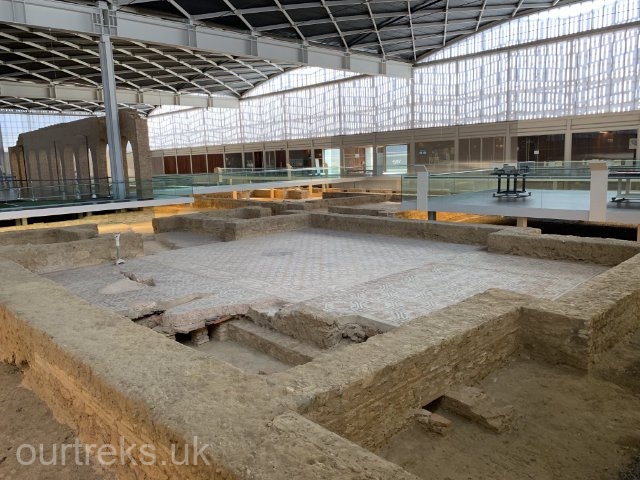
Here in the middle of nowhere sits the most amazing Roman find in all Spain, the Roman villa at La Olmeda also known as VRO Olmeda. We park on the car park, have lunch then walk down to the glass and steel structure that covers the villa remains found in 1968 in a local farmer’s field. As a cultural heritage building admission is very cheap €6 each for adults and €4 for concessions, which also includes admission to the museum in the nearby town of Saldaña.
Inside, the extent of the villa and the mosaics laid on the floors and still intact, takes our breath away. After its discovery and careful archaeological excavation (which took about twenty years) and some careful reconstruction, it was covered and opened to the public. La Olmeda is one of the most important archaeological sites in the Spanish Roman world, a large rural villa built around the 1st or 2nd century A.D. It is unknown who lived there but clearly it was a wealthy Roman family who built and lived in this mansion.
Overall, the main building is square and arranged around a central courtyard with peristyle, from its four galleried corridors the different room and sections of the house open: living and entertaining rooms, dining rooms, bedrooms, Roman baths and latrines, most rooms paved with mosaics. The servants and service quarters were separate. This villa covers an area of 4400 m2 with 35 rooms divided between the main house and the Baths complex and 26 of them (1450 m2) are decorated with mosaics, all preserved in situ. We spend the afternoon transported back to the second and third centuries and how this family would have lived.
While we don’t know who they were, we know what they look like because there are ‘miniatures’ of them laid within the border of the floor mosaic in the main entertaining room. Young people, middle aged people, straight hair, curly hair, fair and dark hair, all with their individual facial features. Alan buys a large poster of the faces for €2.
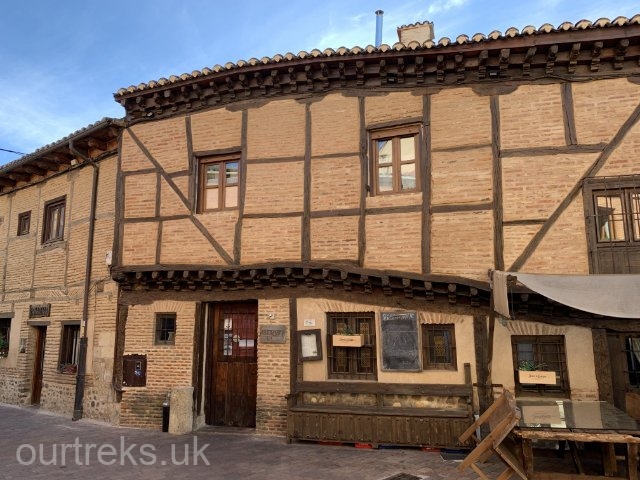
The afternoon flies by and later we drive to the village of Saldaña where we park up on the small Area de servicio para Autocaravanas. We walk about ten minutes into the small town and find the old church that has been converted to a museum, our tickets give us entry.
Here the history and excavated artifacts found in-situ during the excavation are displayed: exquisite jewellery, buckles, bridles, tools, glassware and pottery (smashed but carefully reconstructed). We spend some time here too completely absorbed by what has been found. Later we walk back across the large, pillared square, with cafes and bars around its perimeter. It is late in the season and only a few locals and tourists sit round tables drinking beer and wine. The afternoon is warm and sunny, 22°C and we enjoy the calm and ambiance of the town.
The Roman family must have been very content here until the barbarians came in the fourth century, smashing and pillaging anything Roman. Villa Romana must have escaped the worst of it, perhaps they fled before the worst of it began.
Back at the Hymer we see that all seven places (with electricity) are full, and others had parked on the adjoining flat rough ground shaded by trees, which would have been a good place to spend the night too. We review our photographs over a bottle of cold Alberiño wine and finish the last of the chorizo from Freixo de Numão.
We agree that the visits of the last two days to Las Medulas and Villa Romana La Olmeda have been the best, and the highlights of this trip to Spain.
Gallery Astorga to Saldaña
Click at image to enlarge