2020-03 Spain & Portugal Day 3: Arrival in Santander and travel to Camaleño
Previous day ¦¦ Back to trip summary page. ¦¦ Next day
Santander to Cameleño
The storm continues unabated all night.
We sleep and wake (usually by some noise or what feels like a violent movement). When we awake around 7.00 am, we realise the violent movements have stopped. We get up and can walk around the cabin without falling over. From the porthole we see a relatively calm sea, just moderate waves and undulations, the storm has passed. No wine last night was a very good decision. My mind wanders, I think about cruise ships and wonder what people do during those days ‘at sea’, that’s how the operators describe them, days at sea. Fine for the crew who are working but what do the passengers do? My guess is it’s all eating and drinking, maybe I’m wrong. I guess the passengers would question why we would spend a lot of money on a motorhome, then go driving around Europe sleeping in some very strange places.
We are about level with Bordeaux and heading due south towards Santander. We have a hearty breakfast of bacon, eggs and coffee around 8.00 am, by 8.30 am the café is heaving with hungry people! We return to our cabin, pack our bag in readiness for later and return to the reading room to read and write. Gill completes another good section on William Carruthers (1787) and his ten children. As the morning passes, the dark and foreboding grey sky lifts, first we see the horizon, a lovely sharp line delineates itself, then blue patches of sky appear.
Around midday all the clouds have rolled away to reveal a perfect blue Spanish sky, it is 24˚C outside. Who would believe the storm we have passed through?
We arrive at Santander about 30 minutes late, not bad considering the storm, we drive off the ferry into brilliant sunlight, so bright we scrabble to find our sunglasses. We go straight to the Easygas filling station on the S-10, the busy ring road south, and fill up with diesel at EasyGas, €1/litre, (89p/L Alan notes that at home we are paying around £1.28/L, Spanish diesel is much cheaper than the UK. It does prompt the question about the level of taxation in the UK, some European countries have much lower taxes on fuel and alcohol, particularly wine, so how why is that, and how are these countries raising revenue?
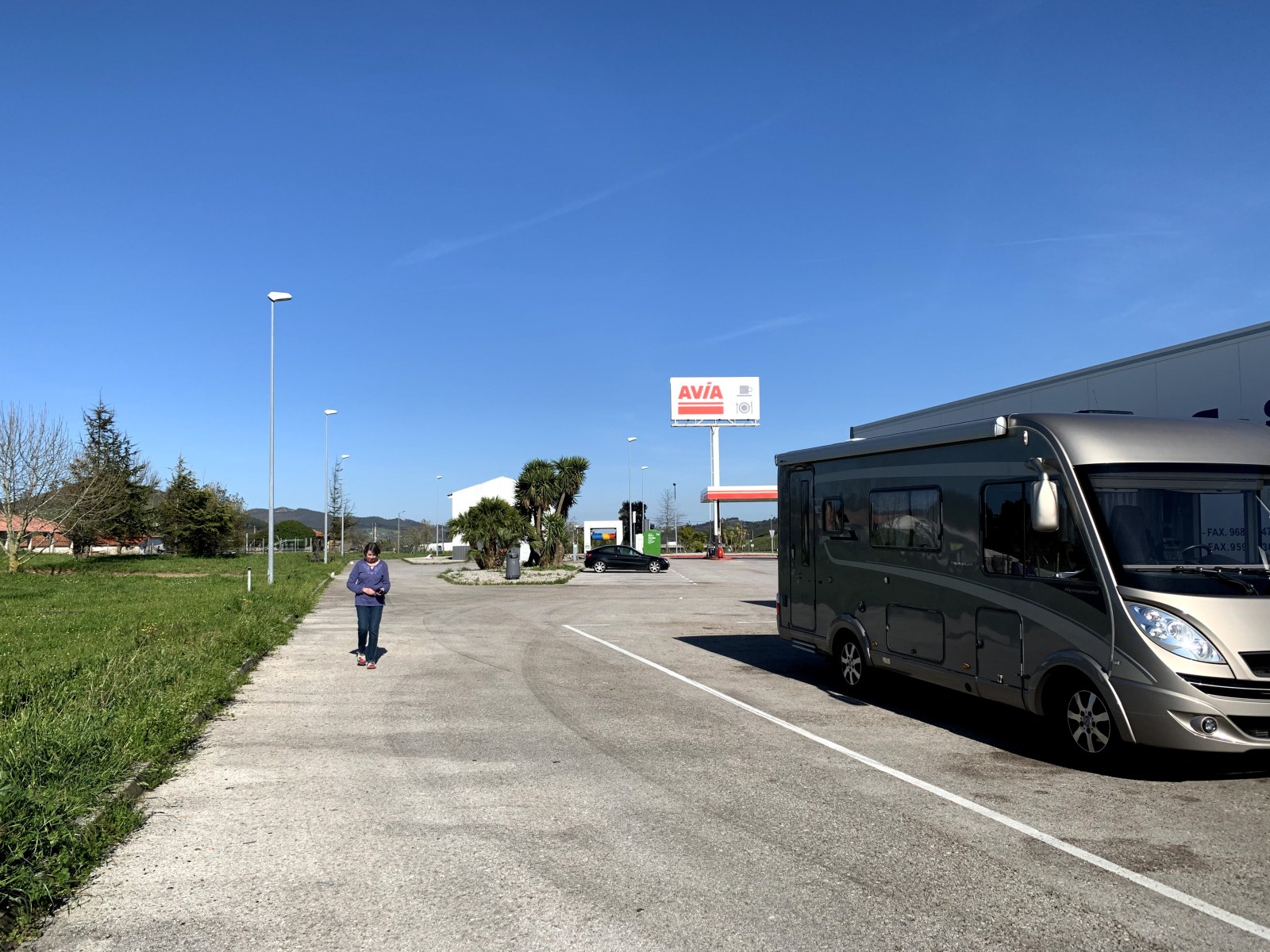
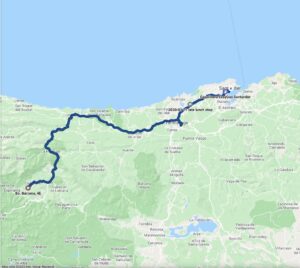
A quick look at the map and we are on our way towards Unquera and the Picos de Europa mountains. We do not go far south along the A-67, we stop for lunch at the first service area near Gornazo. It is now 3.00 pm and the temperature outside is 26˚C. The first thing we do is take off our layers of jumpers and vests and put on cotton t-shirts and shorts. It feels bizarre and very hot!! Back on the A-67 to Torrelevega, then west on the A-8 through Cabezon to Unquera.
Unquera is a medium-sized tourist town with a lovely town centre with central plaza, lots of people and outdoor activities. The road runs along the side of the river (Rio Deva) and follows its loops and bends making it a great location for river rafting. At Unquera we take the N-621 south again following the Rio Deva towards the Picos mountains. A narrower road but quite adequate for two large vehicles to pass. Through some lovely Spanish villages such as La Hermida, another tourist centre for rafting and hiking in the foothills of the mountains and Picos National Park. The hotels are of the Austrian style with curved roofs (for snow) and balconies with troughs of flowers. Along the road are many restaurants and shops, all open and selling basket-ware and cane, including walking sticks (for the Camino de Santiago).
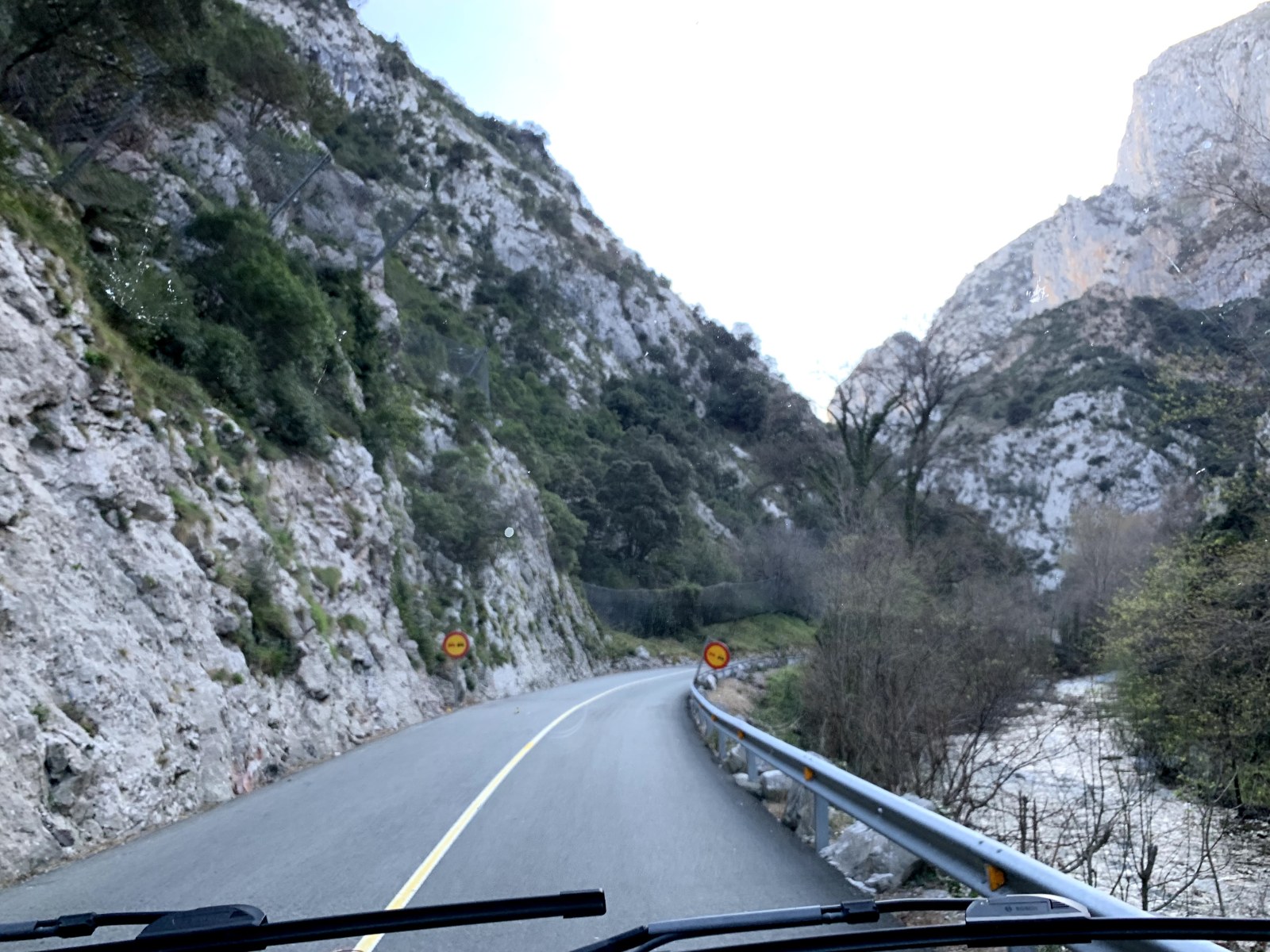
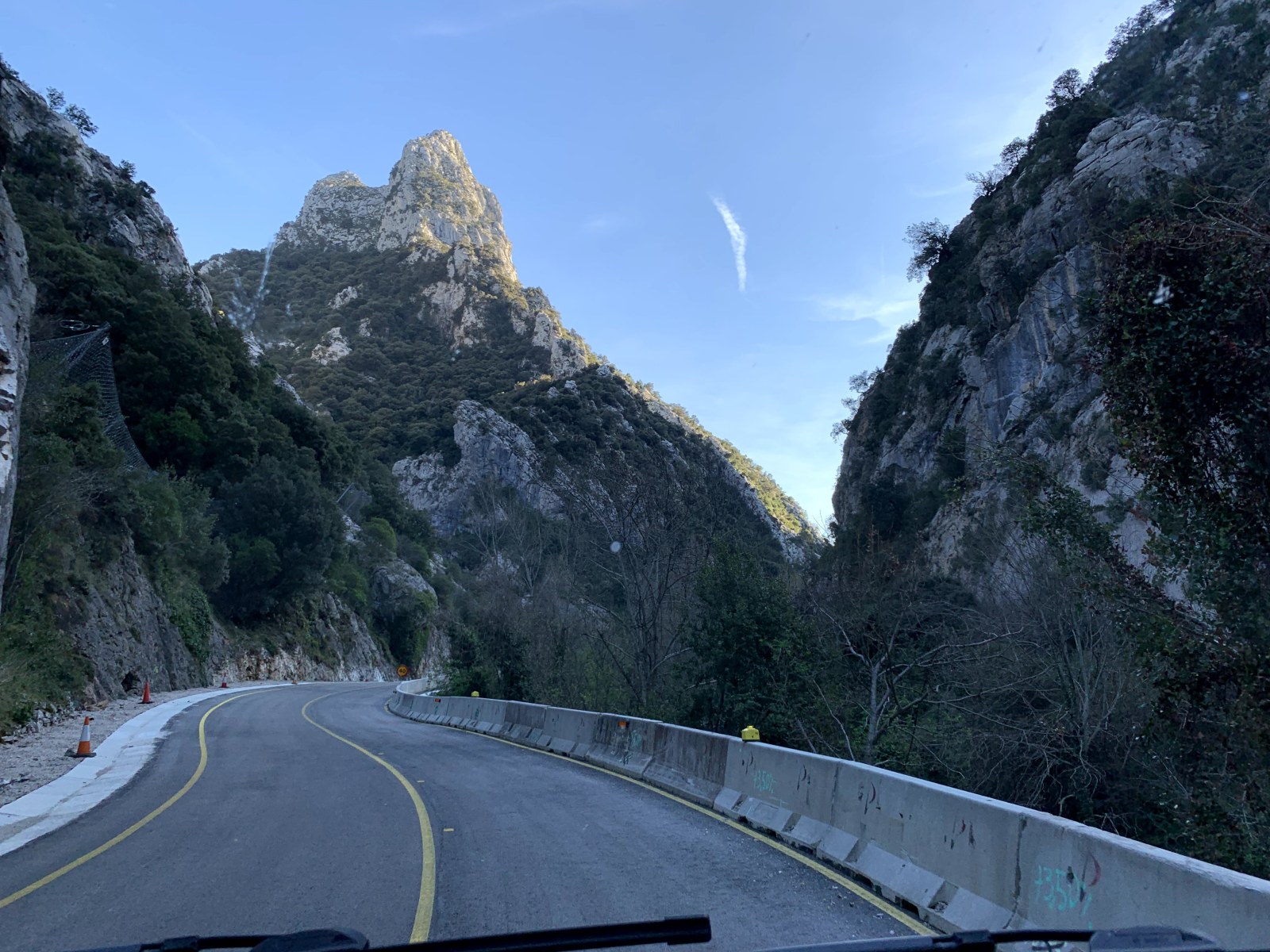
The road gets progressively narrower as we go deeper into the gorge. The gorge itself is very deep, narrow and twisting, blocking out the sun in places, we cross back and forth over the river to Potes. Potes is another lovely town with wonderful old stone-arched colonades along the side of the road, a town meeting area with circular stone stand (a bandstand to us) and steps down to the town plaza, full of tables for eating out. Here (at Potes) we turn onto the CA-185 (Cantabria), a narrow mountain pass, and follow this for 10 km through another deep gorge carved by the Rio Deva to Mogroveja. The gorge is stunning, spectacular in its depth with vertiginous rock-mountain walls. These are sheer and, in places, are over-hanging the road, so that metal mesh balconies have been bolted horizontally into the rock about 30 foot above us. In these metal hammocks are some fair-sized rocks that have hurtled down the vertical rock face from above.
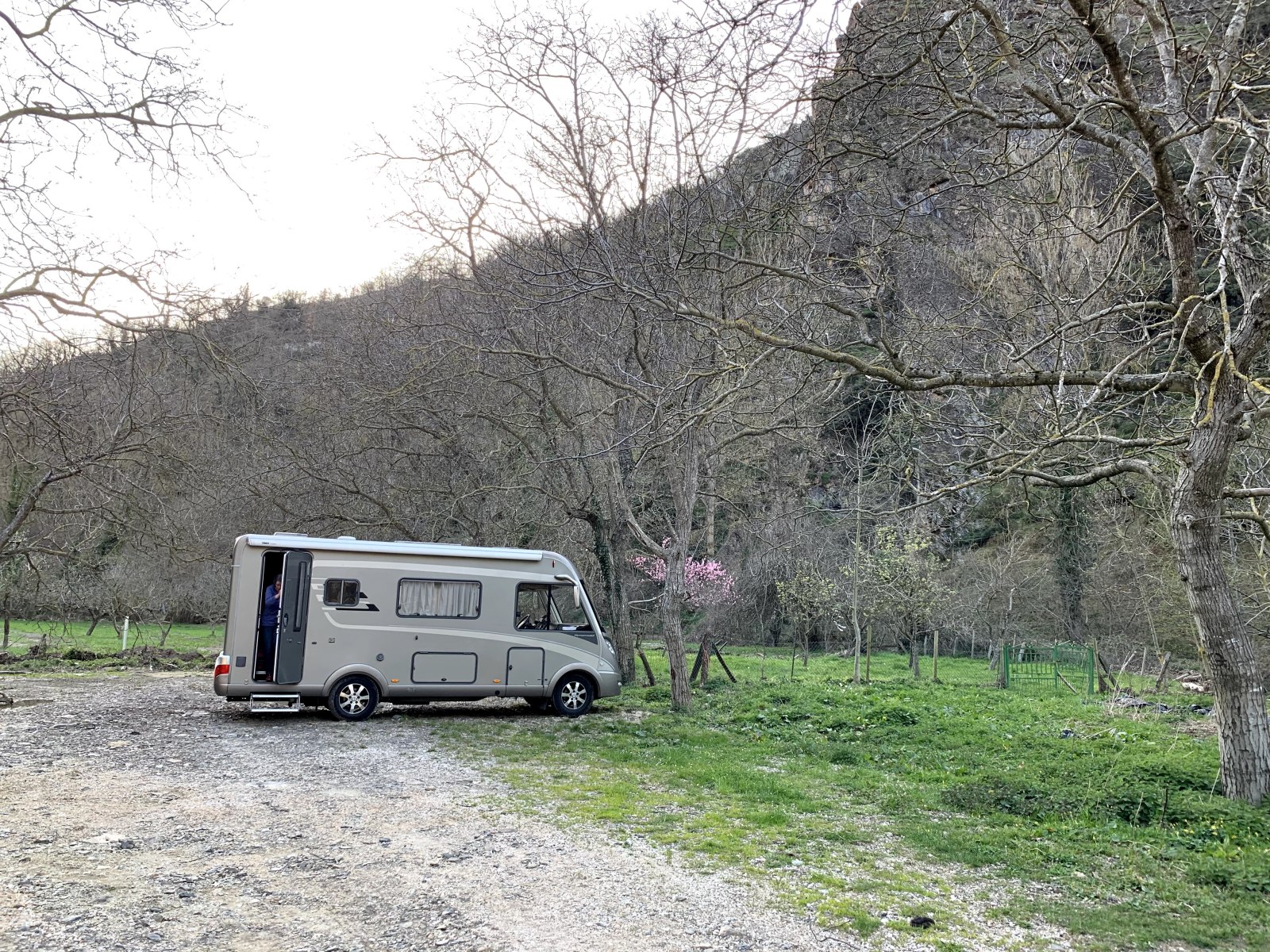
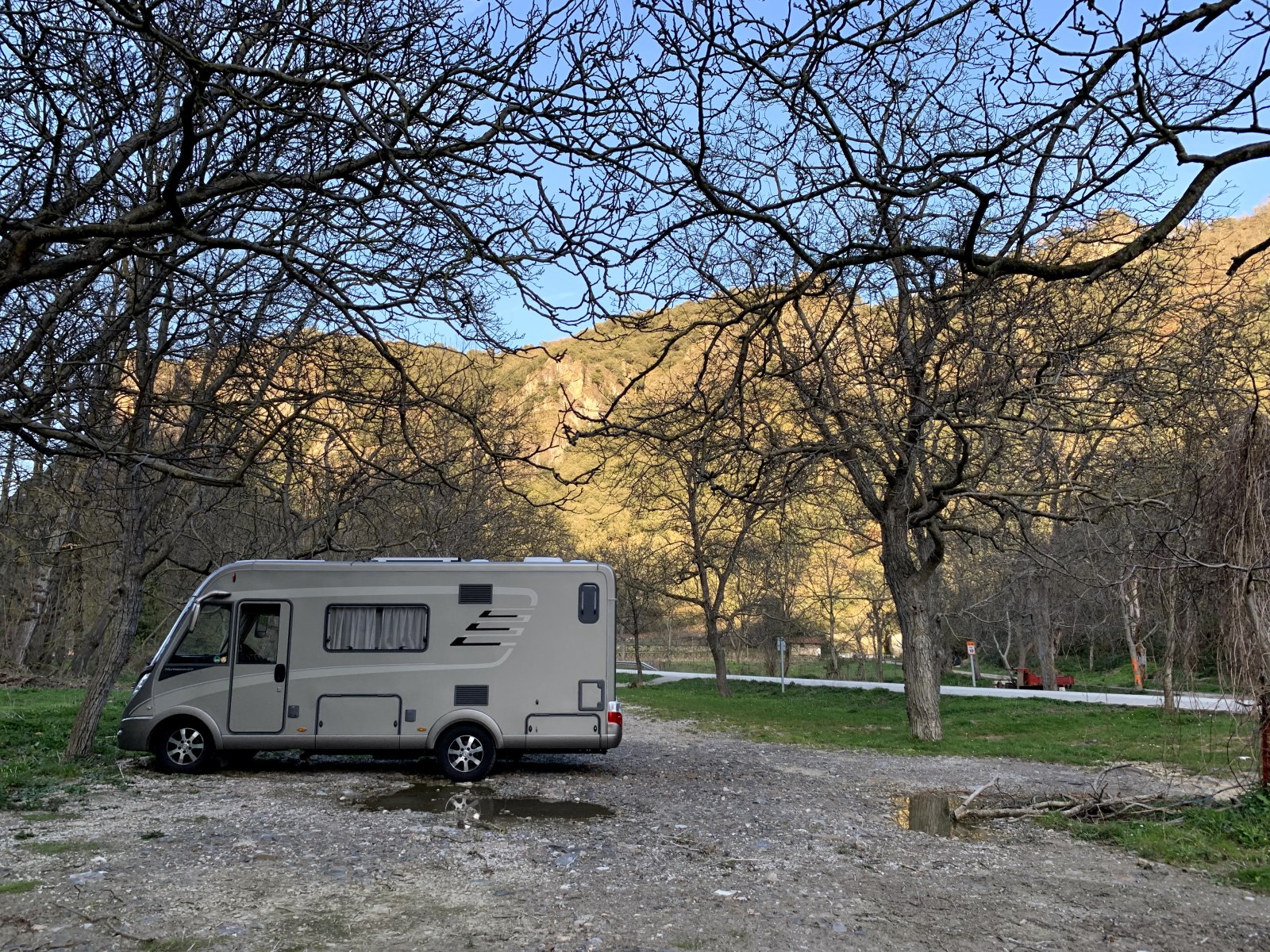
At Mogroveja we come out of the mountain pass into high alpine pasture. At this altitude the road is more or less level between idyllic rolling countryside where sheep, goats and cattle are grazing in the late afternoon sun. Just outside the village of Los Llanos we stop on a small rough and grassy area next to the river. This is our stop for the night. It is quiet and rural, surrounded by cows with bells on (or bells with cows on as Gill says in her tiredness), high mountain ponies, also with bells, and herds of mountain sheep.
We park up and are greeted by a very friendly grey cat! We drink white Agnus (white Rioja) wine and eat stir fry. As it comes dark, we go out into the total blackness of the night. It takes at least 30 – 40 seconds before we can see anything until our eyes are accustomed to the almost total blackness. Finally, the camper looms as a dark shape and we look up into a black, moonless night sky . . . what a sight! The Plough and Orion hardly visible because of the myriad of so many other stars, all we can do is stare in wonder at God’s other worlds out there, a sight we rarely see. We are very tired and are in bed by 9.30 pm.
Previous day ¦¦ Back to trip summary page. ¦¦ Next day
Click any image to enlarge