2024 September: France and Spain – Oil Museum and Hiking to the Dolmen
Previous day || Back to trip summary page || Next day
It is 9°C when we wake here on the free aire outside the oil museum at Sargentes de la Lora, the storm having cleared the air and the high elevation keeping it cool. Four of the seven motorhomes parked here overnight leave and another leaves after lunch.
We have a slow morning, it is cold outside so we catch up with emails, sort photos and plan our route. After an early lunch we put on our walking shoes, walk through the town much of which is either empty or very run down and find the walking trails. These are very well marked, short and long distance trails across the mountains. We find the trail to La Cabaña Dolmen a Megalithic Dolmen, a six-kilometre circular walk which is well-walked and clearly marked.
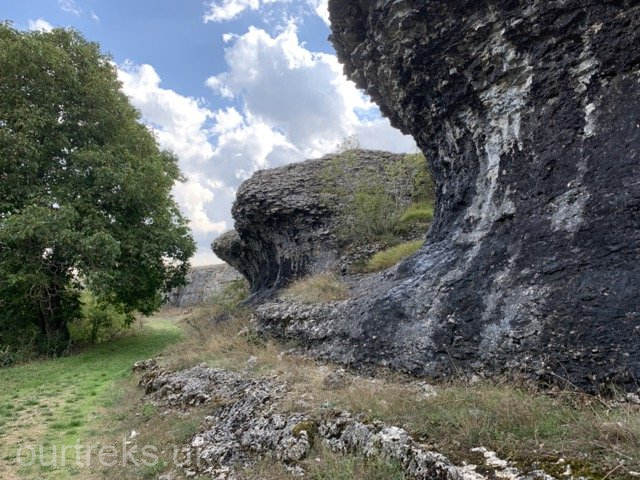
The first part follows the shoulder of the mountain, it is warm and sunny with high-level mountain plants: purple heather, the very prickly echinacea (sea holly), juniper, what looks like a mountain bilberry (but no fruit) and berberis ground cover. It is 3km to the Dolmen and it is well worth the walk.
Background information on dolmens
A dolmen or portal tomb is a type of single-chamber megalithic tomb, usually consisting of two or more upright megaliths supporting a large flat horizontal capstone or “table”. Most date from the Late Neolithic period (4000–3000 BC) and were sometimes covered with earth or smaller stones to form a tumulus (burial mound). Small pad-stones may be wedged between the cap and supporting stones to achieve a level appearance. In many instances, the covering has eroded away, leaving only the stone skeleton.
Only discovered in 1984 and finally excavated in 1993, its dome-shaped mound has the typical deeply cut walkway facing east-west through a short tunnel to a small circular area, about 3m diameter. It is lined with vertical rock slabs about 2m high, its opening formed of two upright stones supporting a flat horizontal capstone.
We stand amid hundreds of pink autumn crocus the top of the hill, in total isolation and, as the sun shines down into its circular cavity and the wind blows across the barren mountain top, we feel the ancientness of this place. The passing of feet 5000 years ago as the ancients walked this same walk at the solstice, to observe the sunrise shining directly through its narrow tunnel to light the chamber. Their only means of calendar, to count the weeks of the seasons. A timeless and mysterious place.
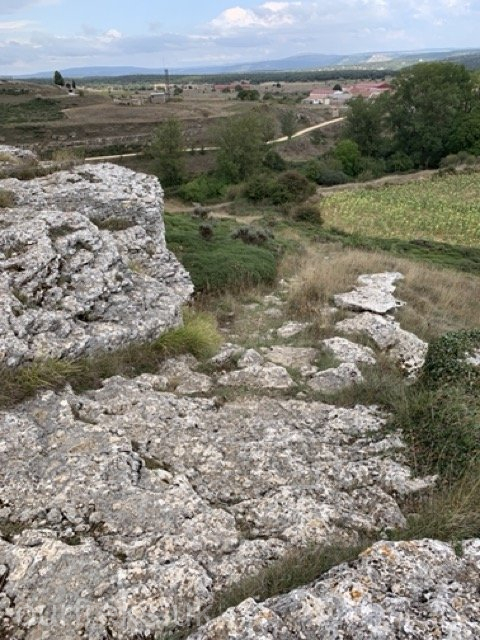
Reluctantly we leave and move on through the autumn crocus underfoot, to the other side of our circular walk. Across the rocky edge overlooking the mountain plateau and down rough-hewn steps in the rock to the grassy and more agricultural area below that leads back to the town. The distance was relatively short (about 7 km) but so interesting, so varied and such excellent quality of trails and signage.
Back at Hymer we have stir-fry for tea and reflect on the last full day of our trip, this has been day 25 at Sargentes de la Lora and the many and varied things we have seen and done.
Photos from – Hiking to the dolmen at Sargentes de la Lora
click any thumbnail image to enlarge