2017-09-20 Spain – Roman and Moorish sites Granada and La Alhambra
Previous Day :: Trek Overview :: Next Day

Spain – Roman and Moorish sites Granada and La Alhambra
Roman and Moorish Sites in Spain by Hymer Motorhome
La Alhambra visit to Granada from Conchar
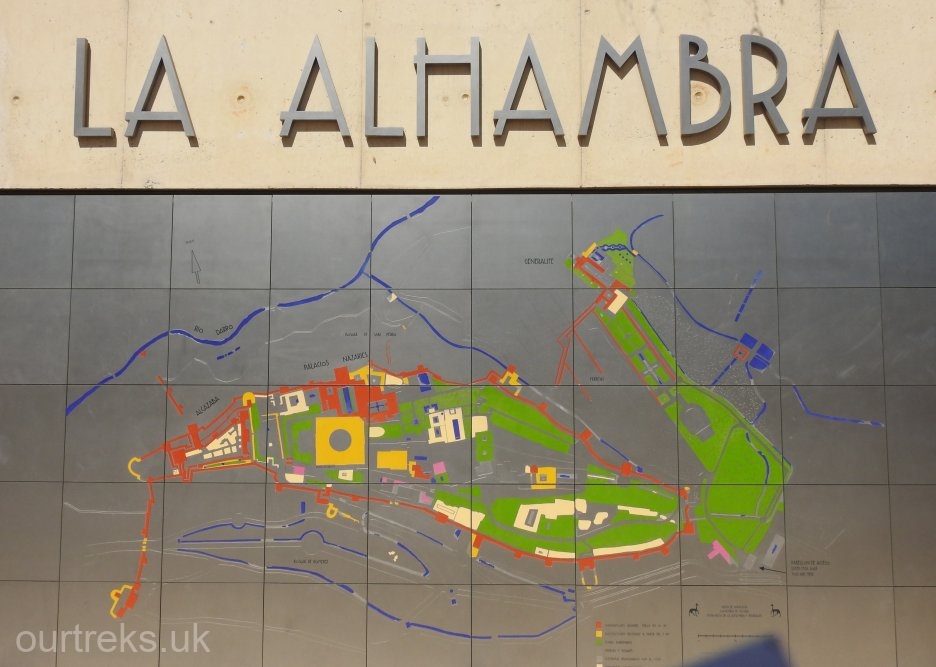
Another hot and sunny day with a clear blue sky. We wake late, eat breakfast on the terrace, Julian and Geneva do their laundry and we have a lazy morning with more serenading by our wanna-be opera singer. After an early lunch, we leave for the Alhambra around 12.30 and drive to the Generalife car parks on top of the hill by the Alhambra. An easy journey and plenty of parking even if you have to pay for it. This is a major tourist attraction so adequate parking is a must.
It is just after 1.00pm and hot, about 30°C. Three of us need to provide ID for our tickets as we are over 65 years, we go to the box office and discover that only EU nationals qualify, so Julian has to pay another €5, which feels like a small amount of the overall cost of a trip from Canada (€20 instead of €15). We enter the Alhambra and wander down to the Nazrid’s Palace as our entry time is 14.00, we join the queue which is relatively short at 13.35, but lengthens as the allocated 300 people arrive for that time slot.
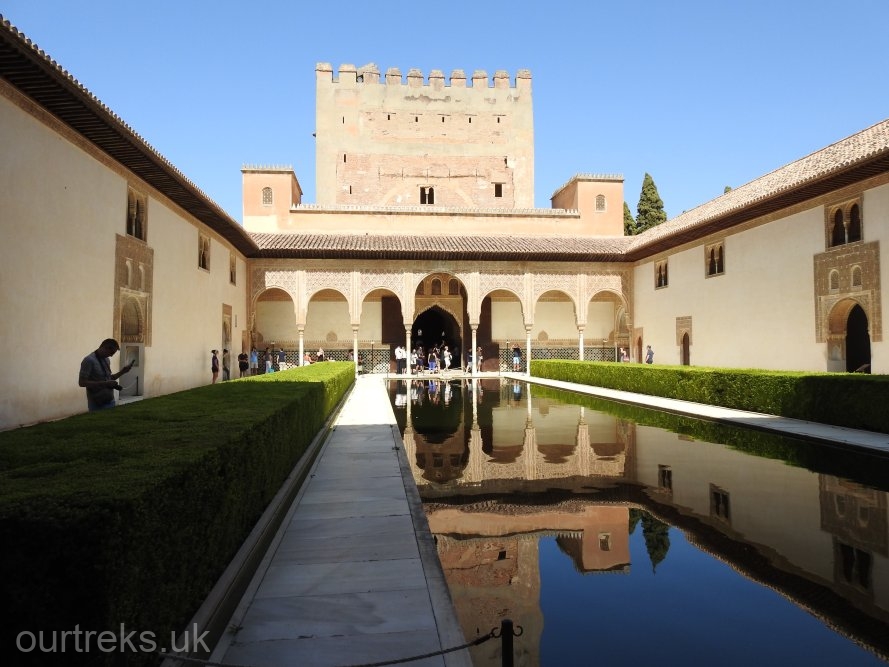
We are admitted at exactly 14.00 and we begin our tour of the palace of the Nazrids. It was originally constructed as a fortress in AD 889 on the remains of Roman fortifications. It was largely ignored until the mid-13th century by the Moorish Emir, Mohammed I (founder of the Nazrid dynasty). He began renovations in 1238, taking 35 years to build a palatial city next to and extending the original fortress. In 1333 Ismail I, Sultan of Granada, ordered the building of the first of the Nazrene Palaces: the Mexuar, and Yusif I ordered the building of the Palace of Comares with its rectangular courtyard enclosing a beautiful reflecting pool. Both are breath-taking, especially when one considers they are almost 700 years old.
Entering through fairly simple orange/brown stonework, you make your way into the palace itself, emerging from an ornate room into a courtyard surrounded by a colonnade of white marble pillars with a rectangular reflecting pool in the centre. The floor too is set in white marble with channels of water running around the perimeter of the pool, the channels of water having small fountains giving the constant background ‘sush’ of flowing water… restful and perfect for covering up the sound of whispered secrets! The movement of this water contrasts totally with the silent and still pool with its mirror finish, reflecting back the white pillars and blue sky… a marvellous sight for the eyes!
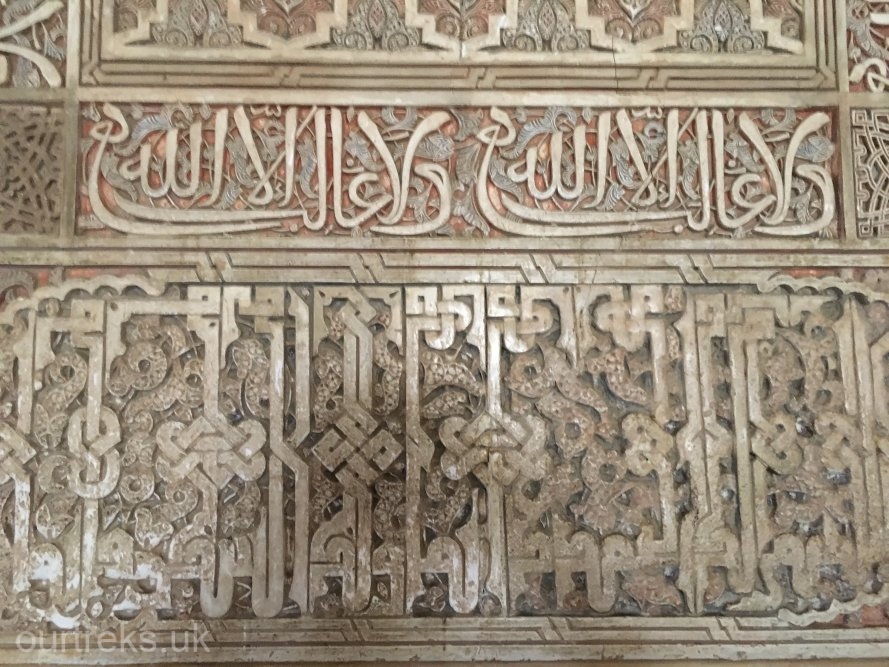
Inside, the rooms are equally magnificent. The lower third of the walls are decorated with ceramic tiles painted in the typical Moorish geometric design and colours of deep blue, mustard brown and white, some with a deep maroon red instead of blue. Above these, a dado made of a narrow line of different tiles separates the upper part of the walls. These are covered with ornately carved stucco plaster (rather than stone) and covered with inscriptions in Arabic of poems that praise the palace and its Sultan. This moulded plasterwork, set in geometrical patterns is also painted in the same colours as the tiles, although the colours have faded over the centuries and been lost altogether in places.
The ceilings are constructed with ornate cut and moulded wood of different shapes, types and colours. Together with the pillars and horseshoe doors, each room opening onto a courtyard, the overall impression is magnificent. 1362, Mohammed V, orders the building of the Palace de Los Leones, also with a rectangular reflecting pool, in an enclosed courtyard, the central fountain being a circle of 12 white marble lions, each has a mouth as a water spout. All the palace buildings are quadrangular, all the rooms opening on to a central court with ornate reflecting pools, so that the gradual addition of new quadrangles of varying dimensions was possible by connecting each with the next by smaller rooms and thick stone passages so that the interior is always cool. All are different and each breath taking in design.
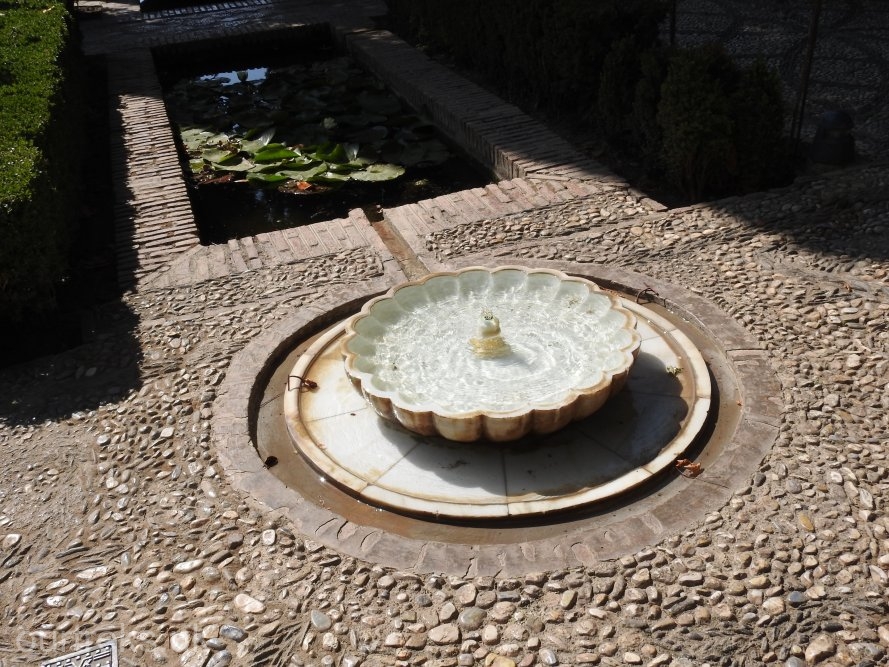
The use of water in the floor, in shallow white marble circles linked by small channels flowing between the palaces creates an overall impression of symmetry, beauty and tranquillity. What a place to live in the 14th century! The decoration of the walls is similar throughout, with the Moorish painted ceramic tiles below a dado line of exquisitely decorated narrow tiles and the upper part of the painted plaster stucco with various patterns and inscriptions. Sometimes there are tile mosaics with complicated mathematical patterns panelling the lower third of the walls. Sometimes, similar designs are displayed on wooden ceilings.
The Moorish dynasty lasted until 1492 when, after the Christian conquest, the Royal Court of Ferdinand and Isabella incorporate the Alhambra into the crown and it assumed a military function. It was here that Christopher Columbus (a citizen of Granada) received royal endorsement for his expedition. In 1526, Carlos V, as Holy Roman Emperor, commissioned a new Renaissance palace to be built inside the Alhambra. In comparison, it is plain and somewhat ugly. On seeing it he is reputed to have said that they had destroyed something beautiful to build something ugly, and I would agree. A rectangular building with circular central courtyard (the best part). I spent about 20 minutes in this part and over three hours in the Nazaries Palaces, with their constantly changing colours, designs and gardens, beautiful in their Moorish style.
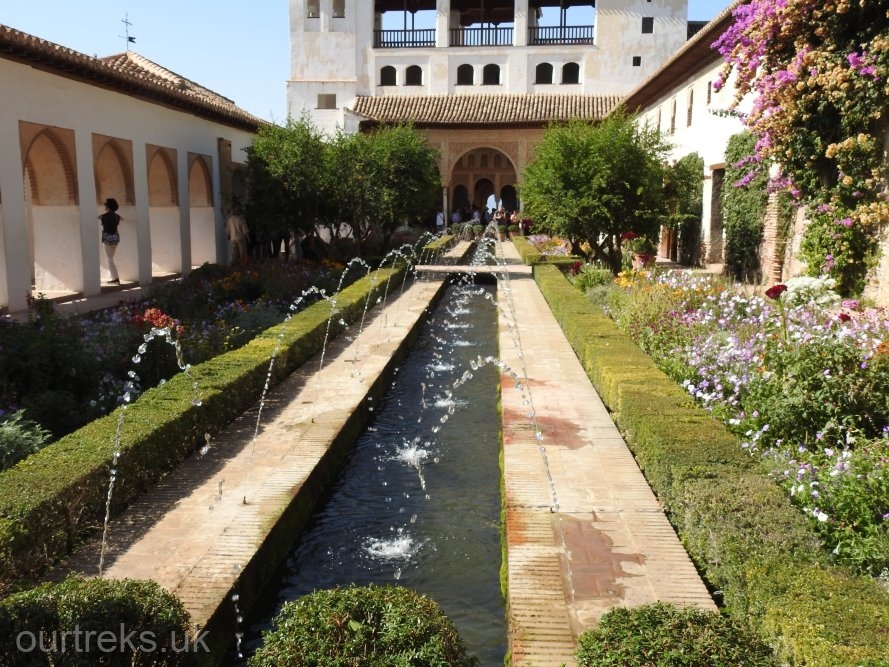
Having got separated from Mr C. I wander through the palace rooms and courtyards absorbing the history and sense of place the building give in their Moorish context. Passing from the palaces into the gardens, I notice the intense heat outside, compared to the everlasting coolness provided by the heavy construction of the walls, open windows (no glass) allowing the breeze to pass through and the constant water flowing through the shallow marble channels. It gave a whole new meaning to ‘watching where one stepped’! Eventually I find Mr C. and we wander through the gardens into the much later addition of the Generalife gardens, it is very relaxing.
Three hours pass very quickly and we meet, as arranged, with Julian and Geneva at 5.00pm and wander for another hour or so. Around 6.00pm we cross out of the Alhambra onto the Paseo de la Sabica to Restaurant Jardin Alberto. We sit on an upper terrace overlooking the walls of the Alhambra, and order wine, beer and a meal of chicken cooked Nazrid style with figs, spinach and honey. I note the plain and austere exterior of the walls (compared with the overly-ornate interiors) and the orange-red colour cast on the stone by the setting sun and remember that Alhambra means the red one in Arabic… it is aptly named. What a day
Our Hymer motorhome trip to Roman and Moorish Sites in Spain



Keywords: Motorhome, Hymer, B544, Premiumline, Spain, Motorhome trip Europe, camping car europe, camping car tour